Multimedia University, Melaka · PhD researcher

Applied AI for biosignals, SEM imaging, rehabilitation systems, and medical imaging.

Lew Kai Liang is a PhD researcher at Multimedia University working across biosignals, rehabilitation systems, SEM image analysis, and medical imaging, with public proof across IEEE Xplore, Google Scholar, and ORCID.

Scholar snapshot, March 17, 2026: 20 works, 70 citations, h-index 5.

  • IEEE Access publication
  • Multimedia University PhD
  • ORCID public record
  • 20 works / 70 citations
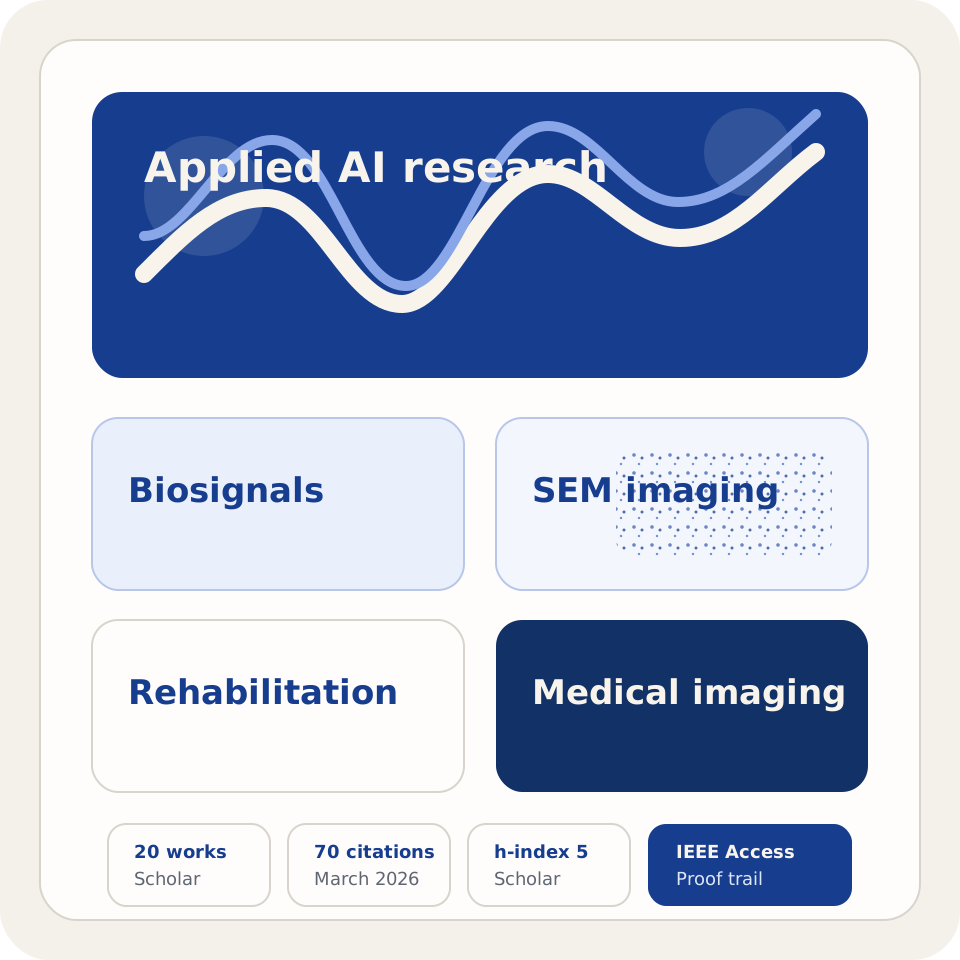
Research collage showing SEM imaging, biosignal traces, medical imaging, and publication highlights from Lew Kai Liang's work.
Selected outputs across SEM imaging, EEG classification, rehabilitation systems, and medical imaging.

Selected Work

Three projects that explain the range of the research.

Each example shows the problem, the approach, the measurable result, and why the work matters.

SEM image analysis · IEEE Access (2025)

SEM Deep Learning Multiclass Noise Level Classification With Data Augmentation

Problem
SEM images lose quality under varying noise levels, which makes downstream inspection less reliable.
Method
Deep learning pipeline with augmentation for multiclass noise-level classification in SEM imaging.
Result
Published in IEEE Access in 2025 and listed on both IEEE Xplore and Google Scholar.
Why it matters
It turns image-quality assessment into something more systematic for semiconductor, materials, and microscopy workflows.

Biosignals · JOIV (2024)

Deep Learning Approach EEG Signal Classification

Problem
EEG classification is noisy, high-variance, and difficult to stabilize across real-world signals.
Method
NeuroNetFlex combined 1D-CNN, squeeze-and-excitation, and recurrent fusion layers for EEG signal modeling.
Result
Reported 75.33% accuracy in JOIV (2024) and is listed on both Scholar and ORCID.
Why it matters
It reflects the core pattern in the portfolio: using machine learning to make physiological data more actionable.

Rehabilitation systems · Engineering Letters (2021)

Virtual Reality Post Stroke Upper Limb Assessment using Unreal Engine 4

Problem
Upper-limb rehabilitation assessment is often repetitive, hard to standardize, and not especially engaging for patients.
Method
Virtual-reality-based assessment environment backed by motion tracking and related rehabilitation research outputs.
Result
Published in Engineering Letters as part of a broader rehabilitation research line.
Why it matters
It shows the research is not limited to papers; it moves toward applied systems with clinical and usability implications.

Research Themes

Four areas define the portfolio better than a giant tool list ever could.

Biosignals

EEG, EMG, and ECG-driven research on classification, biofeedback, and physiological interpretation.

Representative outputs: EEG signal classification, biofeedback assessment.

Rehabilitation Systems

Virtual-reality and feedback-driven systems for upper-limb assessment, neurofeedback, and rehabilitation workflows.

Representative outputs: post-stroke VR assessment, biofeedback assessment, and neurofeedback systems.

SEM Image Analysis

Deep learning for classification, estimation, and denoising in SEM imaging where noise directly affects interpretability.

Representative outputs: IEEE Access SEM work, single-image SEM estimation.

Medical Imaging

Applied image enhancement and AI-assisted analysis for diagnostic and clinical imaging contexts.

Representative outputs: CT denoising, breast-imaging analysis work.

Supporting stack

  • PyTorch
  • Scikit-learn
  • OpenCV
  • NumPy
  • MATLAB
  • ImageJ
  • Unreal Engine 4
  • Python
  • JavaScript
  • Git

About

A researcher profile built around applied signals and images.

Lew Kai Liang is a researcher at Multimedia University whose work connects machine learning, signal processing, and healthcare-adjacent systems. Across his publications, he has worked on EEG, EMG, and ECG-based biofeedback, virtual-reality upper-limb assessment, CT image denoising, and deep learning methods for SEM image analysis.

He received a B.Eng. (Hons.) in 2019 and an M.Sc. in Engineering in 2022 from Multimedia University, where he is now pursuing a PhD. The current emphasis is SEM image analysis, while the broader portfolio remains clearly interdisciplinary rather than confined to a single niche.

Location Melaka, Malaysia
Affiliation Multimedia University

Timeline

Education and research progression.

2022 - Present

Doctor of Philosophy (PhD), Multimedia University

Current research focus: SEM image analysis, including classification, estimation, and denoising, with connected work in medical AI.

2019 - 2022

Master of Science in Engineering, Multimedia University

Research emphasis on virtual-reality rehabilitation, biosignals, and machine-learning-assisted assessment systems.

2015 - 2019

Bachelor of Engineering (Hons.), Multimedia University

Foundation in electronics, computer engineering, and the technical systems that later shaped the research portfolio.

Evidence

Proof, not padding.

The strongest public references are grouped here so the claims remain easy to verify.

Selected publication trail

  • IEEE Access (2025) SEM Deep Learning Multiclass Noise Level Classification With Data Augmentation
  • JOIV (2024) Deep Learning Approach EEG Signal Classification
  • Engineering Letters (2022) Biofeedback Upper Limb Assessment Using EEG, EMG, and ECG with Machine Learning
  • Engineering Letters (2021) Virtual Reality Post Stroke Upper Limb Assessment using Unreal Engine 4
  • JOIV (2025) Single Image Estimation Techniques for SEM Imaging System

Selected awards

  • Gold Medal, i2RPC 2022 Left And Right Brain Balancing Application with EEG Neurofeedback System
  • Gold Medal, MMU FET Innovative & Inventive Research Project 2022 Rehabilitation using Biofeedback System
  • Silver Medal & TISIAS Special Award, iCAN 2020 Virtual Reality Upper Limb Rehabilitation

Patent references

The grant numbers are retained below the fold because a direct public record URL for each grant was not surfaced cleanly in the implementation pass. The official Malaysian patent search portal is linked.

  • MY-204139-A A system and method for virtual reality rehabilitation training
  • MY-202261-A Virtual reality based rehabilitation